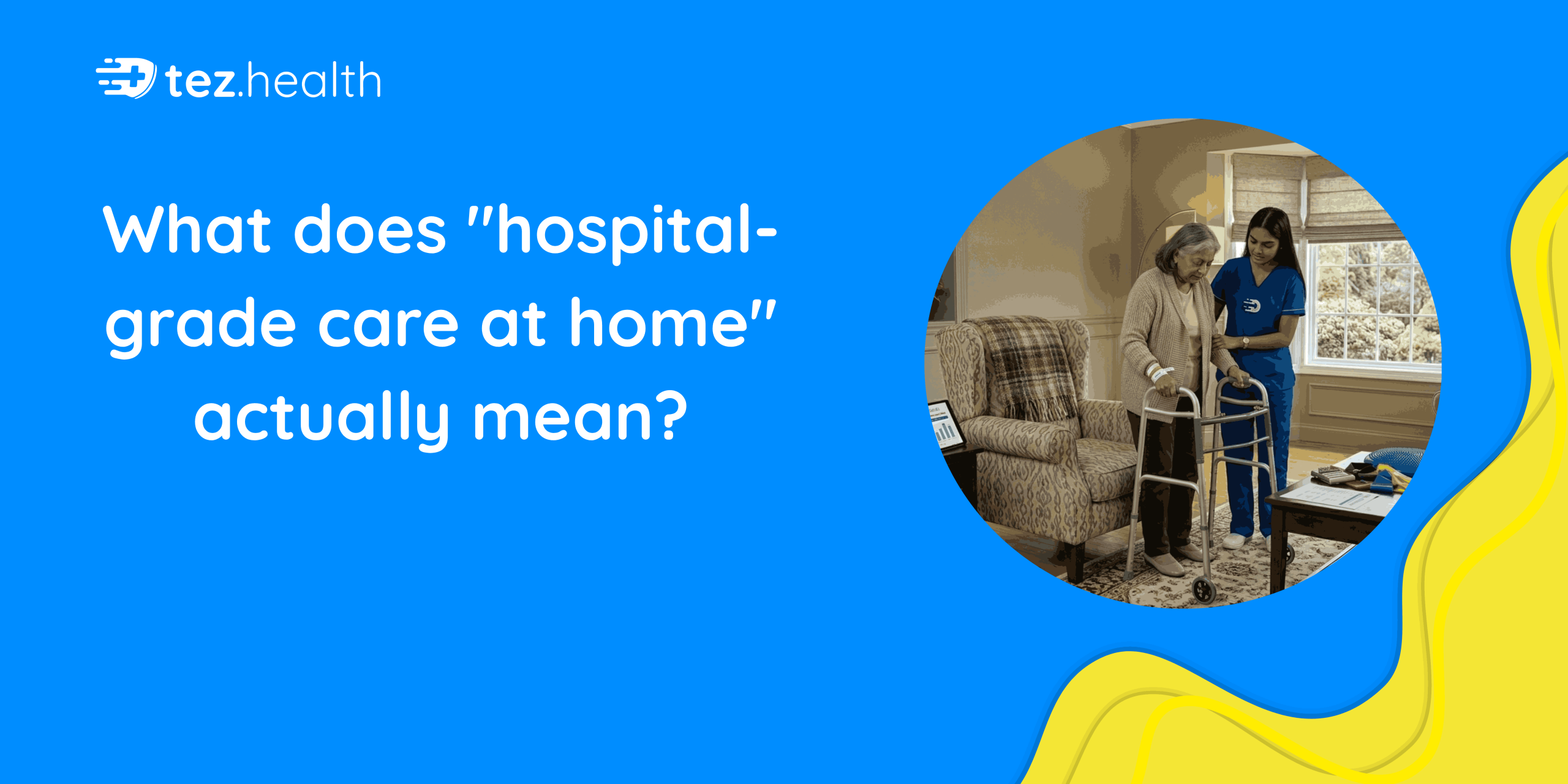
“Hospital-grade care at home” is a phrase that’s everywhere today.
It sounds reassuring. It suggests that patients can receive the same level of treatment they would get in a hospital—without leaving their home.
For many families, that promise is appealing.
But it also raises an important question:
Is this level of care actually possible at home?
And if it is, can India consistently deliver it?
To answer that, we need to move beyond the phrase and understand what hospital-grade care actually involves.
Hospital-Grade Care Is About Standards, Not Location
When people think of hospital care, they often think of buildings, rooms, and equipment.
But hospitals are not defined by their walls.
They are defined by:
- Medical expertise
- Continuous monitoring
- Clinical processes
- Accountability
So when we talk about hospital-grade care at home, we are not talking about recreating a hospital.
We are talking about maintaining the same level of clinical quality and discipline, even outside a hospital setting.
The Three Essentials of Hospital-Grade Care at Home
For care at home to truly match hospital standards, three elements must come together.
1. Skilled Medical Professionals
Hospitals rely on trained doctors and nurses to manage patients.
At home, the same level of expertise is required.
This means:
- Qualified nurses with clinical experience
- Doctor-led treatment plans
- Trained caregivers who understand medical protocols
Without skilled professionals, the quality of care cannot match hospital standards.
2. Clinical-Grade Equipment
Hospitals use specialized equipment to monitor and treat patients.
At home, similar tools must be used, such as:
- Vital sign monitors
- Oxygen systems
- Infusion devices
- Rehabilitation equipment
These are not basic tools—they must meet medical-grade standards to ensure accuracy and safety.
3. Structured Systems and Protocols
Hospitals function through systems.
Every step—from diagnosis to treatment—is guided by protocols.
To deliver hospital-grade care at home:
- Care must follow clear medical processes
- You must maintain records properly.
- You must follow hygiene and safety standards.
- You must define emergency procedures.
This structure is what ensures consistency and reliability.
A Common Misunderstanding
Many people assume that hospital-grade care at home means building a mini hospital inside the house.
That’s not realistic—and it’s not necessary.
Hospitals are designed for:
- Emergencies
- Surgeries
- Intensive interventions
Home-based care is designed for:
- Recovery
- Monitoring
- Long-term management
The goal is not to copy a hospital—it is to deliver equivalent care where it is medically appropriate
What Type of Care Can Be Delivered at Home?
Not every medical service can move to the home—but many can.
1. Post-Discharge Recovery
Patients with post-discharge recovery they often still needs:
- Wound care
- Medication management
- Monitoring
These can be safely handled at home with proper support.
2. Chronic Condition Management
Conditions like diabetes or heart disease require ongoing care.
At home, patients can receive:
- Regular monitoring
- Medication support
- Lifestyle guidance
This makes long-term care more consistent.
3. Rehabilitation Services
Recovery from injury or surgery often requires physiotherapy.
At-home rehabilitation allows patients to:
- Recover in a comfortable setting
- Maintain consistency in therapy
4. Elderly Care
Older patients often need both medical and daily support.
Home-based elder care helps them:
- Stay in familiar surroundings
- Receive regular attention
5. Palliative Care
When treatment focuses on comfort rather than cure, home becomes the most suitable environment.
Patients receive:
- Pain management
- Emotional support
- Dignified care
6. Limited ICU-Level Support
In certain stable cases, patients may receive:
- Oxygen therapy
- Continuous monitoring
- Skilled nursing care
However, this requires strict medical supervision.
What Cannot Be Replaced by Home Care?
Despite advancements, some aspects of healthcare must remain in hospitals.
These include:
- Emergency interventions
- Major surgeries
- Complex diagnostics
- Multi-specialty coordination
Hospitals are essential for these situations.
Home care works alongside them—not instead of them.
Can India Deliver Hospital-Grade Care at Home?
Now let’s address the main question.
Yes, India can deliver it—but only when certain conditions are met.
Why India Is Ready for This Shift
1. Strong Medical Talent
India has a large number of trained healthcare professionals.
With the right training and systems, this workforce can support home-based care effectively.
2. Rapid Growth of Health Technology
Technology is enabling care beyond hospitals.
Today, patients can access:
- Online consultations
- Remote monitoring
- Digital health records
This makes it easier to maintain clinical standards at home.
3. Increasing Patient Demand
Patients today want:
- Convenience
- Faster access
- Reduced hospital visits
This demand is pushing providers to improve home-based services.
Challenges That Still Exist
While the potential is strong, there are real challenges.
1. Lack of Standardization
Not all providers follow the same quality standards.
This leads to variations in care.
2. Training for Home-Based Care
Providing care at home requires different skills than working in a hospital.
Healthcare professionals need:
- Independent decision-making ability
- Strong observation skills
- Emergency awareness
3. Home Infrastructure Limitations
Not every home is suitable for advanced care.
Factors like:
- Space
- Cleanliness
- Power supply
Can impact service quality.
4. Emergency Response Delays
Hospitals offer immediate access to:
- Specialists
- Equipment
- Emergency care
At home, response time can be slower.
This is one of the biggest limitations.
What Makes Home Care Truly “Hospital-Grade”?
The difference lies in execution.
1. Doctor-Supervised Care
Care must always be guided by medical professionals.
2. Continuous Monitoring
Patients must be tracked regularly and consistently.
3. Clear Clinical Protocols
Every step must follow structured medical guidelines.
4. Skilled and Verified Staff
Professionals must be trained and experienced.
5. Emergency Preparedness
There must always be a plan for quick escalation if needed.
The Risk of Overpromising
The term “hospital-grade” is often used loosely.
When providers fail to meet actual standards, it can lead to:
- Safety concerns
- Delayed treatment
- Loss of trust
Patients should always evaluate the actual quality of care—not just the label.
The Tez Health Approach
At Tez Health, hospital-grade care at home is not treated as a marketing term.
It is treated as a responsibility.
This means focusing on:
1. Medical Accuracy
Every service must meet clinical standards.
2. Structured Systems
Care must be organized and consistent.
3. Continuous Monitoring
Patients must be tracked without gaps.
4. Emergency Readiness
Clear plans must be in place for critical situations.
5. Patient-Centric Care
Comfort matters—but safety comes first.
What This Means for Patients
For patients, this shift offers new possibilities—but also requires informed decisions.
Before choosing home-based care, ask:
- Is the care medically supervised?
- Are the professionals qualified?
- Is the equipment reliable?
- Is there an emergency plan?
Understanding these factors helps ensure safe and effective care.
Final Thoughts
So, what does “hospital-grade care at home” really mean?
It means delivering healthcare at home with the same level of quality, discipline, and medical oversight that hospitals provide—within safe and appropriate limits.
And can India deliver it?
Yes—but only when providers maintain high standards and patients choose carefully.
This is not about replacing hospitals.
It is about making healthcare more accessible, more comfortable, and more aligned with patient needs.
At Tez Health, the goal is simple:
Bring high-quality care closer to patients—without compromising on safety or reliability.
Because in healthcare, quality is not defined by location.
It is defined by how well care is delivered—every single time.