


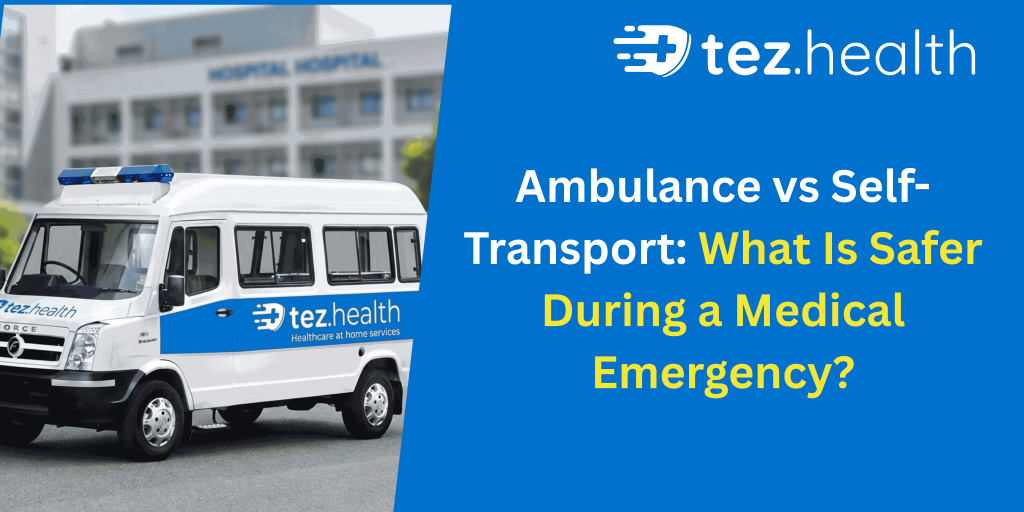
A Detailed Guide on Why Choosing an Ambulance Can Save Lives
When a medical emergency strikes, panic often takes over. Families instinctively rush to move the patient to the nearest hospital — sometimes using a private car, auto-rickshaw, bike, or taxi. The thought process is simple: “It’s faster if we just take them ourselves.”
But in reality, self-transport during a medical emergency can significantly increase risk.
In critical situations like heart attack, stroke, trauma, severe breathing difficulty, seizures, or unconsciousness, the journey to the hospital is not just transportation — it is a continuation of medical care.
This comprehensive blog explores:
- What qualifies as a medical emergency
- Risks of self-transport
- Life-saving advantages of ambulance services
- Differences between Basic Life Support (BLS) and Advanced Life Support (ALS) ambulances
- Real-world emergency scenarios
- Legal and safety considerations
- Cost vs survival analysis
- Why choosing an ambulance is often the safer decision
Understanding Medical Emergencies
A medical emergency is any condition that threatens life, limb, or long-term health and requires immediate medical intervention.
Common emergencies include:
- Heart attack (myocardial infarction)
- Stroke
- Severe trauma or accident
- Unconsciousness
- Seizures
- Severe asthma attack
- Anaphylaxis (severe allergic reaction)
- Major bleeding
- Cardiac arrest
In such situations, every minute matters.
The “Golden Hour” principle in emergency medicine highlights that early intervention significantly improves survival outcomes. However, that intervention should begin immediately — not only upon arrival at the hospital.
The Common Mistake: Choosing Self-Transport
Many families believe:
- Driving themselves is faster
- Ambulances take time to arrive
- It is more affordable
- The condition “isn’t that serious”
Unfortunately, emergencies can deteriorate suddenly during transit.
Self-transport lacks:
- Medical monitoring
- Oxygen support
- Trained paramedics
- Emergency medications
- Defibrillation equipment
- Airway management tools
A private vehicle is not equipped to handle sudden complications.
What Happens Inside an Ambulance?
An ambulance is not just a vehicle. It is a mobile emergency unit.
Depending on the type, it may include:
- Oxygen cylinders
- Suction apparatus
- Cardiac monitor
- Defibrillator
- IV fluids
- Emergency medications
- Ventilator (in ALS ambulances)
- Trained paramedic or nurse
Ambulances provide pre-hospital care, which bridges the gap between home and hospital.
The Risk of Deterioration During Transport
Medical emergencies are unpredictable.
Consider these examples:
- A heart attack patient may go into cardiac arrest en-route.
- A stroke patient may develop seizures.
- A trauma victim may experience sudden blood pressure collapse.
- A breathing difficulty patient may lose airway patency.
In a private car, there is no immediate intervention available.
In an ambulance:
- CPR can begin instantly
- Oxygen can be administered
- IV access can be secured
- Cardiac rhythm can be monitored
- Defibrillation can be performed
Early intervention dramatically improves survival rates.
Case Scenario 1: Heart Attack
A patient experiencing chest pain and sweating is rushed to the hospital in a private car.
Halfway there:
- The patient collapses
- Becomes unresponsive
- Stops breathing
Family members panic.
There is no defibrillator, no CPR-trained professional, and no oxygen.
Contrast this with ambulance transport:
- Continuous ECG monitoring
- Oxygen support
- IV medications
- Immediate CPR
- Defibrillation if required
The difference could mean survival versus fatality.
Case Scenario 2: Road Accident Trauma
A road accident victim may have:
- Internal bleeding
- Neck or spinal injury
- Head trauma
Improper movement during self-transport can worsen spinal damage, potentially causing permanent paralysis.
Ambulance services:
- Use cervical collars
- Use spine boards
- Stabilize fractures
- Control bleeding
- Provide IV fluids
Safe immobilization prevents secondary injury.
Case Scenario 3: Stroke
In stroke, “time is brain.”
Each minute of untreated stroke can destroy millions of brain cells.
Ambulance services:
- Pre-alert hospital stroke team
- Monitor vital signs
- Manage blood pressure
- Provide oxygen
Pre-hospital notification shortens treatment delay upon arrival.
Self-transport does not offer coordinated care.
Psychological Impact of Self-Transport
Family members driving during emergencies face:
- Panic
- Emotional distress
- Poor decision-making
- Increased accident risk
Distracted driving during medical emergencies increases road accident risk.
Ambulance professionals remain calm, trained, and focused.
Ambulance Types: Understanding the Difference
Basic Life Support (BLS) Ambulance
BLS is Equipped for:
- Oxygen administration
- Basic airway support
- Bleeding control
- CPR
- Transport for stable patients
Suitable for:
- Non-critical emergencies
- Stable patients needing supervision
Advanced Life Support (ALS) Ambulance
ALS is Equipped with:
- Cardiac monitor
- Defibrillator
- Ventilator
- Emergency drugs
- Advanced airway management
Staffed by trained paramedics or critical care professionals.
Suitable for:
- Heart attack
- Stroke
- Cardiac arrest
- Severe trauma
- Respiratory failure
Choosing the right ambulance type matters.
Monitoring During Transit
In self-transport:
- No blood pressure monitoring
- No oxygen saturation tracking
- No heart rhythm monitoring
In ambulance:
- Continuous vital monitoring
- Early detection of deterioration
- Immediate response
Monitoring reduces risk of sudden death during transit.
Oxygen: A Critical Factor
Many emergencies involve oxygen deprivation:
- Heart attack
- Stroke
- Asthma
- Pneumonia
- COVID complications
Ambulances provide oxygen therapy immediately.
Private vehicles cannot.
Oxygen support can prevent organ damage during transport.
Legal and Traffic Advantages
Ambulances have:
- Sirens
- Traffic priority
- Right-of-way in many situations
Private vehicles do not.
During peak traffic hours, ambulances may reach hospital faster due to priority passage.
Self-driving through traffic can waste precious time.
Cost vs Life: A Misplaced Comparison
Some families avoid ambulances due to cost concerns.
However:
- The cost of ambulance is small compared to ICU admission.
- Early intervention reduces hospital complications.
- Preventing cardiac arrest avoids extended ICU stays.
Ambulance cost is an investment in survival.
Delayed Complications During Self-Transport
Common risks include:
- Vomiting and aspiration
- Seizures
- Airway blockage
- Sudden unconsciousness
- Severe hypotension
- Cardiac arrest
Without medical personnel, these can become fatal.
Pediatric and Elderly Emergencies
Children and elderly patients are more vulnerable.
Children may:
- Rapidly deteriorate
- Require airway support
Elderly patients may:
- Have multiple underlying conditions
- Experience sudden collapse
Ambulance care provides professional monitoring.
When Is Self-Transport Acceptable?
Self-transport may be considered if:
- The condition is minor
- The patient is fully conscious
- No breathing difficulty
- No chest pain
- No severe trauma
- Hospital is very close
However, any uncertainty favors ambulance use.
Misconception: “Ambulance Takes Too Long”
Modern ambulance networks:
- Use GPS tracking
- Deploy nearest vehicle
- Provide estimated arrival time
In urban areas, response times are often optimized.
Even if there is a short wait, the medical care provided during transit outweighs the delay.
Emergency Preparedness Matters
Calling an ambulance ensures:
- Pre-arrival medical instructions
- Professional assessment
- Appropriate equipment dispatch
Dispatch teams guide families until ambulance arrives.
Self-transport offers no such guidance.
Public Health Perspective
Globally, emergency medical services (EMS) reduce mortality rates.
Countries with structured EMS systems show:
- Improved cardiac arrest survival
- Better trauma outcomes
- Reduced disability rates
Pre-hospital care is a recognized medical specialty for a reason.
Ambulance as Mobile ICU
Advanced ambulances function like mini-ICUs.
They can:
- Intubate patients
- Administer IV drugs
- Perform defibrillation
- Stabilize blood pressure
- Manage shock
Private cars cannot replicate this environment.
Real-Life Survival Statistics
Studies show:
- Early CPR doubles or triples survival rates in cardiac arrest.
- Defibrillation within minutes dramatically increases survival.
- Trauma stabilization before hospital reduces mortality.
Ambulance services deliver these early interventions.
Emotional Reassurance for Families
Having trained professionals present:
- Reduces panic
- Provides reassurance
- Allows family to focus on patient
- Improves confidence
During emergencies, professional calm matters.
Why Choosing Ambulance Is Safer
Choosing an ambulance ensures:
- Continuous medical supervision
- Oxygen availability
- Emergency medication
- Airway management
- Defibrillation capability
- Safe immobilization
- Professional monitoring
- Traffic priority
Self-transport offers none of these safeguards.
Frequently Asked Questions
1. Is it always necessary to call an ambulance during emergency?
If the condition involves chest pain, stroke symptoms, severe trauma, breathing difficulty, or unconsciousness — yes.
2. Are ambulances faster than private cars?
In many cases, yes, due to traffic priority and coordinated dispatch.
3. Is ambulance service expensive?
Costs vary, but the benefit of immediate medical care far outweighs the expense.
4. What if the hospital is only 5 minutes away?
Even within 5 minutes, cardiac arrest or airway collapse can occur. Medical supervision remains safer.
5. Can ambulance staff provide treatment before hospital arrival?
Yes. They provide pre-hospital emergency care, including CPR, oxygen, and medication.
Conclusion
During a medical emergency, the journey to the hospital is part of treatment.
Self-transport may seem quicker, but it lacks life-saving support.
Ambulance services provide:
- Immediate medical intervention
- Professional monitoring
- Equipment readiness
- Safer transport
In emergencies, survival depends on timely and appropriate care — not just reaching the hospital.
When in doubt, choose the safer option.
Choose an ambulance.
Because in critical moments, every second — and every medical action — counts.