
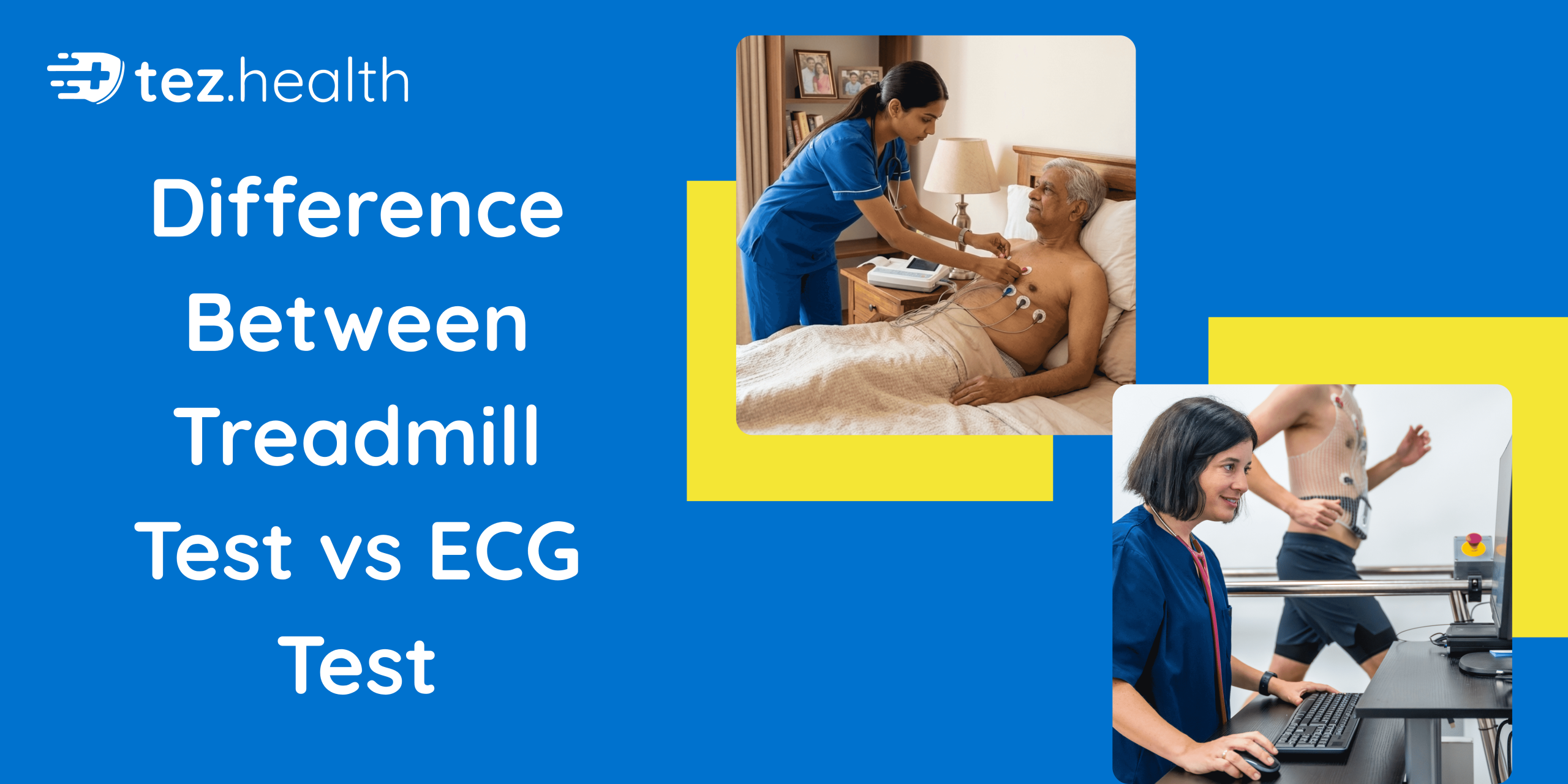
Difference Between Treadmill Test and ECG Test begins with understanding that heart care should be quick, convenient, and easily accessible—right from your home. At Tez Health, we bring essential cardiac monitoring to your doorstep so you can take the first step toward better heart health without hospital visits. While advanced tests like the Treadmill Test (TMT) require clinical setups, a simple and effective ECG (Electrocardiogram) test at home can help detect many early signs of heart conditions. Our trained professionals conduct ECG tests quickly and accurately, helping identify irregular heart rhythms and potential risks within minutes—without long queues or stress. While TMT supports advanced diagnosis, starting with an ECG at home is often the smartest and most practical approach to proactive heart care.
Introduction to Heart Health Testing
Heart diseases are among the leading health concerns worldwide. Early detection is key to preventing serious complications. Diagnostic tests like ECG and TMT are commonly used to assess heart function, but they serve different purposes.
Understanding the difference between these two tests can help you make informed decisions about your heart health.
What is an ECG Test?
An ECG (Electrocardiogram) is a simple, non-invasive test that records the electrical activity of the heart. It helps detect irregularities in heart rhythm and structure.
What Does an ECG Detect?
- Irregular heartbeats (arrhythmias)
- Heart attack (current or previous)
- Poor blood flow to the heart
- Structural abnormalities
Advantages of ECG
- Quick and painless
- No physical effort required
- Can be done at home
- Ideal for routine screening
What is a Treadmill Test (TMT)?
A Treadmill Test (TMT), also known as a stress test, evaluates how your heart performs under physical exertion.
During the test, you walk or run on a treadmill while your heart activity is monitored.
Key Differences Between TMT and ECG
| Feature | ECG Test | TMT Test |
| Type of Test | Resting test | Stress test |
| Purpose | Basic heart screening | Detect blockages under stress |
| Procedure | No physical activity | Requires exercise |
| Duration | 5–10 minutes | 30–45 minutes |
| Location | Can be done at home | Requires hospital setup |
| Comfort Level | Very comfortable | Physically demanding |
| Risk Level | Minimal | Slightly higher |
| Use Case | Early detection | Advanced diagnosis |
When is an ECG Test Recommended?
An ECG test is usually the first step in heart evaluation. It is recommended if you experience:
- Chest pain
- Palpitations
- Dizziness
- Shortness of breath
- Routine health check-ups
With Tez Health, you can easily get an ECG test done at home without any hassle.
When is a TMT Test Recommended?
A TMT test is suggested when:
- ECG results are inconclusive
- Symptoms occur during physical activity
- There is a need to evaluate exercise tolerance
- There is suspicion of coronary artery disease
Why ECG is the First Step in Heart Diagnosis
Most heart evaluations begin with an ECG because:
- It provides immediate results
- It is simple and non-invasive
- It helps decide if further testing like TMT is needed
ECG acts as a screening tool before moving to more complex procedures.
Benefits of ECG at Home with TEZ Health
1. Convenience
No need to travel or wait in hospitals.
2. Quick Results
Testing and results are delivered within minutes.
3. Comfortable Experience
Ideal for elderly and high-risk patients.
4. Early Detection
Helps identify issues before they become serious.
5. Safe and Reliable
Performed by trained professionals.
Limitations of ECG and TMT
ECG Limitations
- May not detect issues that occur only during exercise
- Limited in diagnosing blockages
TMT Limitations
- Requires physical effort
- Not suitable for all patients
- Needs hospital setup
ECG vs TMT: Which Test Do You Need?
The choice depends on your condition:
- For routine screening → ECG
- For advanced diagnosis → TMT
- For elderly or high-risk patients → ECG preferred
Starting with ECG is always recommended.
Role of Preventive Healthcare
Preventive healthcare is essential for reducing heart disease risks. Regular ECG testing can:
- Detect problems early
- Reduce emergency situations
- Improve long-term health outcomes
Common Symptoms That Require Immediate Testing
Do not ignore:
- Chest discomfort
- Irregular heartbeat
- Fatigue
- Breathlessness
An ECG at home can help identify the cause quickly.
Lifestyle Tips for Better Heart Health
- Eat a balanced diet
- Exercise regularly
- Avoid smoking
- Manage stress
- Get regular ECG check-ups
Conclusion
Both ECG and TMT tests play important roles in heart health monitoring, but they serve different purposes. While TMT is useful for advanced diagnosis under stress, ECG is the most practical and essential first step.
With TEZ Health’s ECG at home services, you can monitor your heart health conveniently, safely, and efficiently. Early detection through ECG can help prevent serious complications and guide timely treatment.
Taking the first step toward heart health has never been easier.
FAQs (Frequently Asked Questions)
1. What is the main difference between ECG and TMT?
ECG measures heart activity at rest, while TMT evaluates heart function during exercise.
2. Can ECG detect heart problems early?
Yes, ECG can identify many heart abnormalities early.
3. Is ECG at home reliable?
Yes, when done by trained professionals like TEZ Health.
4. When should I take a TMT test?
When ECG results are unclear or symptoms occur during activity.
5. Is TMT test safe?
Yes, it is safe under medical supervision.
6. How long does an ECG test take?
About 5–10 minutes.
7. Can elderly patients do ECG at home?
Yes, it is highly recommended.
8. Do I need preparation for ECG?
No special preparation is required.
9. Which test is better for routine check-up?
ECG is better for routine screening.
10. How can I book ECG at home?
You can easily book through Tez Health for quick doorstep service.