


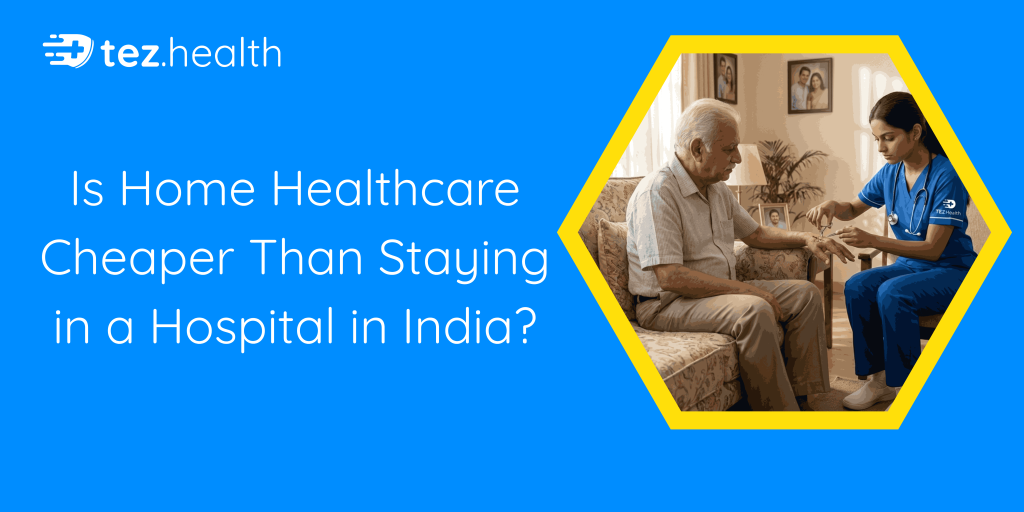
Healthcare decisions are often emotional—but they are also deeply financial.
In India, one of the most common questions families ask during illness or recovery is:
“Should we continue treatment in a hospital, or bring care home?”
Behind this question lies a major concern:
cost.
Hospital bills can escalate quickly, especially in private healthcare settings. At the same time, home healthcare services are becoming more accessible, structured, and medically advanced.
So, is home healthcare actually cheaper than staying in a hospital?
The answer is: in many cases, yes—but it depends on the type of care required.
At Tez Health, where the goal is to deliver fast, reliable medical care at home, it’s important to break down this comparison honestly—so patients and families can make informed decisions.
Understanding the True Cost of Hospital Care in India
When people think about hospital expenses, they usually think of room charges or doctor fees.
But the reality is far more complex.
A hospital bill typically includes:
- Room or ICU bed charges
- Doctor consultation fees
- Nursing care
- Diagnostic tests and lab investigations
- Medications and consumables
- Equipment usage
- Administrative and facility charges
Even a short hospital stay can involve multiple layers of expenses.
For example:
- Regular ward charges can range from ₹5,000 to ₹15,000 per day
- ICU costs can go as high as ₹25,000 to ₹50,000 per day
- Extended ICU stays can result in bills running into several lakhs
And these are just the direct costs.
There are also indirect expenses such as:
- Travel to and from the hospital
- Food and accommodation for family members
- Loss of income due to time off work
When all of this is combined, hospitalization can become financially overwhelming—especially for middle-class families.
What Does Home Healthcare Cost in India?
Home healthcare operates differently.
Instead of paying for an entire hospital ecosystem, you pay only for the services you need.
Typical home healthcare costs include:
- Nurse visits or full-time nursing care
- Doctor home consultations
- Physiotherapy sessions
- Medical equipment rental (oxygen, monitors, etc.)
- Medication and supplies
For example:
- Nursing visits can range from a few hundred to a few thousand rupees per visit
- Monthly nursing care may range between ₹25,000 to ₹60,000
- Physiotherapy sessions may cost ₹500 to ₹1,200 per session
Even advanced care like home ICU setups is available at significantly lower daily costs compared to hospital ICU care.
This cost structure makes home healthcare more flexible and often more affordable—especially for long-term care.
Why Home Healthcare Is Often Cheaper
There are several reasons why home healthcare can reduce overall medical expenses.
1. No Room Charges or Facility Fees
Hospitals charge for infrastructure—beds, rooms, utilities, and facilities. At home, these costs simply do not exist. You are not paying for the hospital—you are paying only for the care.
2. Reduced Need for Unnecessary Tests
Hospitals often follow standard protocols that may include multiple tests and procedures. At home, care is more focused and personalized, which can reduce unnecessary investigations.
3. Lower Risk of Complications
Hospital stays can sometimes lead to:
- Infections
- Medication errors
- Additional complications
These can increase both recovery time and costs. Home care reduces such risks, potentially avoiding additional expenses.
4. Shorter Recovery Time
Patients often recover faster at home due to:
- Familiar environment
- Better rest
- Emotional comfort
Faster recovery means fewer days of care—and lower costs.
5. No Hidden Expenses
Hospital bills can sometimes include unexpected charges. Home healthcare is usually more transparent, with clear service-based pricing.
6. Savings on Non-Medical Costs
At home, families save on:
- Travel
- Food
- Accommodation near hospitals
These savings can be significant over time.
When Home Healthcare Is More Affordable
Home healthcare is typically more cost-effective in the following situations:
1. Post-Surgery Recovery
After discharge, patients often need:
- Wound care
- Medication management
- Physiotherapy
Instead of extending hospital stays, these services can be provided at home at a lower cost.
2. Chronic Disease Management
Conditions like:
- Diabetes
- Hypertension
- Neurological disorders
require ongoing care—not constant hospitalization. Home healthcare allows regular monitoring without repeated hospital expenses.
3. Elderly Care
Long-term hospital stays for elderly patients are not only expensive but also physically and emotionally stressful. Home care provides continuous support at a more sustainable cost.
4. Palliative and Long-Term Care
For patients requiring extended care, hospital costs can become extremely high. Home healthcare offers a more economical and comfortable alternative.
5. ICU-Level Care at Home (Selective Cases)
With proper setup and supervision, certain patients can receive ICU-level care at home at significantly lower costs compared to hospital ICU stays.
When Hospital Care May Be Necessary (and Worth the Cost)
Despite the cost advantages, home healthcare is not suitable for every situation.
There are cases where hospital care is essential.
1. Medical Emergencies
Conditions like heart attacks, strokes, or severe trauma require immediate hospital intervention.
2. Complex Surgeries
Procedures requiring operation theatres and specialized equipment must be done in hospitals.
3. Critical Monitoring
Patients needing constant, high-risk monitoring may require hospital infrastructure.
4. Unstable Conditions
If a patient’s condition is unpredictable, hospital care provides faster emergency response. In these cases, hospital care is not just necessary—it is life-saving.
The Hidden Value of Home Healthcare
While cost is a major factor, home healthcare offers additional value that is often overlooked.
1. Comfort and Familiarity
Healing at home provides psychological comfort that hospitals cannot replicate.
2. Personalized Attention
Care is tailored to the patient, rather than shared among multiple patients in a hospital.
3. Family Involvement
Families can be actively involved in the care process.
4. Better Quality of Life
Patients can maintain a sense of normalcy during recovery. These factors may not appear on a bill—but they significantly impact outcomes.
The Financial Reality for Indian Families
Healthcare expenses in India are largely out-of-pocket.
This means:
- Families often rely on savings
- Medical emergencies can lead to financial strain
- Long hospital stays can impact long-term financial stability
In this context, choosing the right care setting is not just a medical decision—it is a financial one. Home healthcare provides a way to balance both.
The Hybrid Approach: Best of Both Worlds
The most effective approach today is not choosing between home and hospital—but combining both.
This looks like:
- Hospital care for critical treatment
- Home healthcare for recovery and ongoing management
This model ensures:
- Cost efficiency
- Better patient outcomes
- Reduced hospital burden
The Tez Health Perspective
At Tez Health, we believe healthcare should be:
- Accessible
- Affordable
- Reliable
- Patient-focused
Home healthcare is not about replacing hospitals—it is about extending care beyond hospital walls.
That’s why Tez Health offers:
1. Doctor Consultations at Home
So patients don’t need to travel unnecessarily.
2. At-Home Diagnostics
Accurate testing without hospital visits.
3. Nursing and Medical Support
Professional care delivered where it’s needed most.
4. Rapid Response Services
Because healthcare should not be delayed.
5. Integrated Care Experience
From consultation to recovery—all under one system.
This approach ensures that patients receive the right care, at the right time, in the right place.
So, Is Home Healthcare Cheaper?
Let’s answer the question clearly.
Yes, home healthcare is often cheaper than hospital stays—especially for long-term care, recovery, and chronic conditions.
But:
Hospitals remain essential for critical and emergency care.
The key is understanding when to use each.
What Patients Should Consider Before Deciding
Before choosing between home healthcare and hospital care, ask:
- What level of medical care is required?
- Is continuous monitoring needed?
- How long will the treatment last?
- What is the total cost—not just daily charges?
- What will be more comfortable for the patient?
Making the right decision requires balancing medical needs with financial realities.
Final Thoughts
Healthcare in India is evolving—and so are the choices available to patients. Home healthcare is no longer an alternative—it is becoming a preferred model for many types of care.
It offers:
- Cost savings
- Convenience
- Personalized attention
- Better recovery experience
At the same time, hospitals remain critical for complex and emergency care. The smartest approach is not choosing one over the other—but using both wisely.
At Tez Health, we are committed to making healthcare more accessible, more efficient, and more patient-centric—bringing quality care directly to your home without compromising on safety or expertise.
Because in today’s world, the best healthcare is not just about treatment—it’s about delivering care where it truly belongs.