


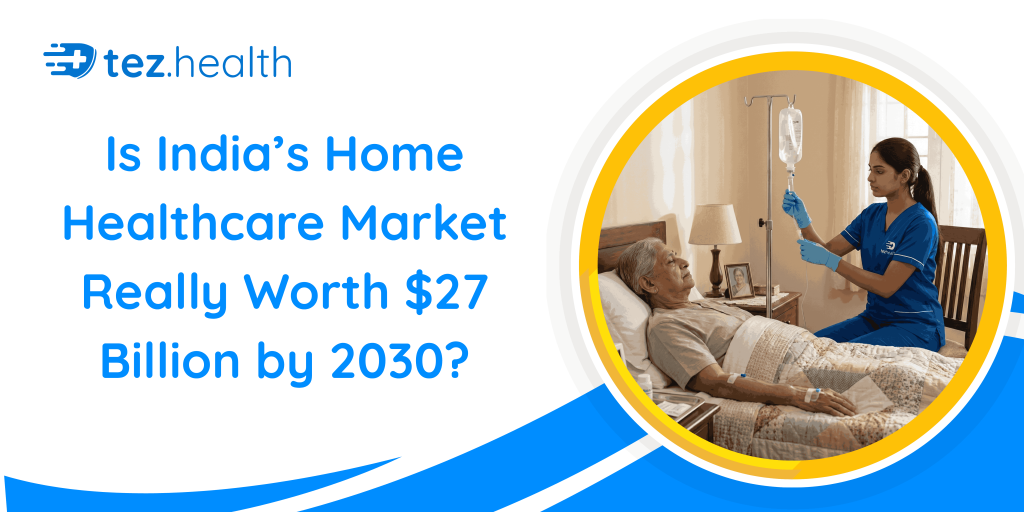
The number sounds impressive.
It’s often quoted as the future size of India’s home healthcare market — and at first glance, it signals massive growth and opportunity. But beyond the headline figure, there’s a more important question to ask:
Is this growth real, sustainable, and meaningful?
Because in healthcare, numbers don’t grow on their own. They are driven by people, needs, behaviors, and systems that are constantly evolving.
To understand whether this projection makes sense, we need to look beyond the number — and focus on what is actually changing in India’s healthcare landscape.
Changing Lifestyles Are Driving Demand
India’s urban population is busier than ever. Long working hours, traffic, and daily responsibilities leave little room for frequent hospital visits. Even something as simple as a routine check-up can become a time-consuming task.
At the same time, health concerns are increasing.
People are dealing with:
- Lifestyle-related conditions
- Stress-driven health issues
- The need for regular monitoring
This creates a gap — and home healthcare fits perfectly into it. It allows people to access care without disrupting their lives.
The Rise of Continuous Care
Healthcare is no longer about one-time treatment. Many conditions today require ongoing attention — not just a single visit to a doctor.
Patients need:
- Regular check-ups
- Monitoring
- Follow-ups
This kind of continuous care is difficult to manage through traditional systems alone. Home healthcare makes it easier by bringing consistency into care. It removes the friction between patients and the services they need regularly.
The Elderly Population Is Growing — Quietly but Rapidly
India may still be seen as a young country, but its elderly population is increasing steadily. With age comes a higher need for healthcare support.
But here’s the challenge:
- Families are becoming smaller
- More people are living in nuclear setups
- Caregivers are not always available
This creates a situation where elderly individuals need support — but don’t always have access to it. Home healthcare becomes the bridge. It allows elderly patients to receive professional care without leaving their homes, while also maintaining their independence and dignity.
Convenience Has Become a Standard
What used to be considered “premium” is now becoming standard.
People expect services to be:
- Fast
- Accessible
- At their doorstep
Healthcare is aligning with this expectation.
The idea of spending hours for a simple test or consultation no longer feels acceptable. Patients want solutions that fit into their schedules, not disrupt them. Home healthcare delivers exactly that. And once people experience it, it becomes difficult to go back to traditional systems.
Cost Isn’t Just About Money — It’s About Value
When people compare home healthcare to traditional clinics, they often focus on price.
But the real comparison is about value.
Home healthcare removes:
- Travel time
- Waiting time
- Multiple visits
It brings:
- Convenience
- Personalized attention
- Faster access
When viewed this way, the cost equation changes. It’s not just about paying for a service — it’s about paying for a better experience.
Technology Is Making It Scalable
A few years ago, home healthcare had limitations. It was difficult to monitor patients remotely or maintain continuity without physical presence.
Today, technology has changed that. With digital tools, healthcare providers can:
- Track patient data
- Stay connected
- Provide timely interventions
This makes home healthcare more reliable and scalable. It is no longer limited to basic services — it is becoming more structured and advanced.
A Lasting Shift in Behavior
Recent years have changed how people approach healthcare.
There is more awareness around:
- Hygiene
- Safety
- Preventive care
People are more cautious about unnecessary hospital visits. They prefer controlled environments and personalized attention. This shift is not temporary. It is becoming a long-term preference. And it is one of the strongest reasons why home healthcare is gaining momentum.
The Market Is Still Evolving
Despite all this growth, home healthcare in India is still at an early stage.
There is still:
- Limited awareness in many regions
- Variability in service quality
- A need to build stronger trust
This means the market has significant room to grow. The $27 billion projection reflects not just current demand, but the potential for expansion.
So, Is $27 Billion Realistic?
The answer depends on how we look at it. If we see it as a fixed number — it may vary. But if we see it as a reflection of direction — it makes sense.
All the key drivers are in place:
- Increasing demand
- Changing expectations
- Growing need for convenience
- Technological support
These factors together create strong momentum. So whether the market reaches exactly $27 billion or slightly more or less is not the main point.
The important point is this:
The growth is real. The shift is happening.
The Bigger Opportunity
The real opportunity is not just in the size of the market.
It is in redefining how healthcare is delivered.
Home healthcare represents:
- Accessibility
- Simplicity
- Personalization
It changes the relationship between patients and care providers.
Instead of healthcare being something people “go to,”
it becomes something that comes to them.
The Tez Health Perspective
At Tez Health, we believe this shift is not just about growth — it’s about responsibility. As healthcare moves into homes, expectations rise.
Patients expect:
- Quick response
- Reliable professionals
- Safe and consistent care
Our focus is on making healthcare:
- Simple to access
- Timely in delivery
- Comfortable for patients
Because real impact comes not from scale alone — but from the quality of care delivered every day.
Conclusion
The question “Is India’s home healthcare market worth $27 billion by 2030?” is important — but it is not the most important question.
A better question is:
Is India ready for healthcare to move into homes?
And the answer is yes.
The demand is growing.
The mindset is changing.
The system is evolving.
The future of healthcare in India is not just bigger — it is closer, more personal, and more accessible. And that is what truly makes this shift meaningful.