


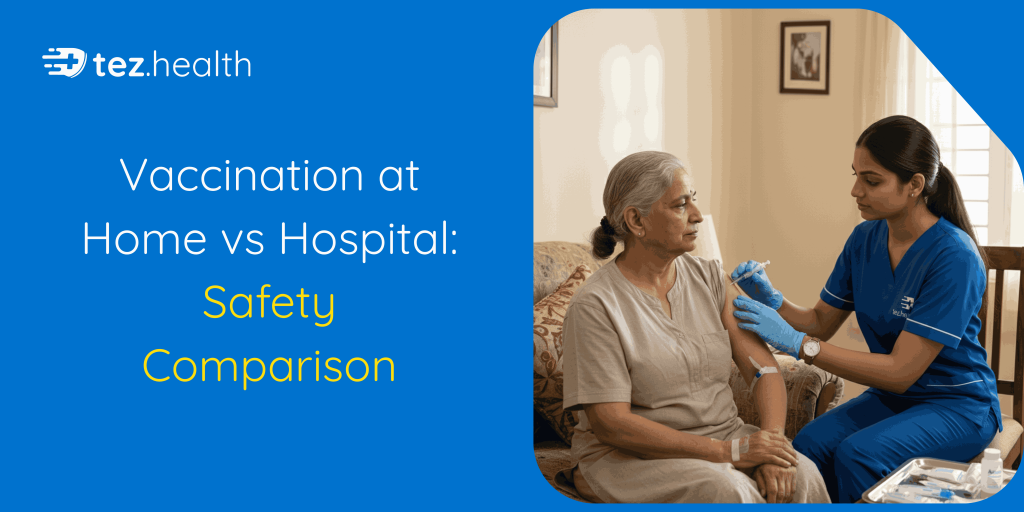
A Detailed Guide to Understanding Where It Is Safer to Get Vaccinated
Vaccination is one of the most powerful preventive healthcare tools available today. From childhood immunization to adult boosters and elderly vaccines, timely vaccination protects individuals and communities from life-threatening infectious diseases.
With the growth of home healthcare services in India, many people now have the option to receive vaccines either:
- At a hospital or clinic
- Through vaccination at home services
This raises a critical and practical question:
Is vaccination at home as safe as vaccination at a hospital?
The answer depends on multiple factors — including patient condition, vaccine type, provider expertise, emergency preparedness, and infection control standards.
In this comprehensive guide, we will explore:
- How vaccination safety is ensured
- Safety protocols followed in hospitals
- Safety protocols followed in home vaccination
- Risk comparison
- Infection control considerations
- Emergency preparedness
- Suitable candidates for home vaccination
- Situations where hospital vaccination is preferable
- Legal and documentation requirements
- Frequently asked questions
This blog aims to provide clarity for patients, families, and caregivers making informed healthcare decisions.
Understanding Vaccine Safety: What Makes Vaccination Safe?
Vaccination safety depends on five major factors:
- Proper vaccine storage (cold chain maintenance)
- Correct dosage and administration technique
- Patient screening before vaccination
- Monitoring for adverse reactions
- Emergency preparedness for rare allergic reactions
Whether administered at home or in a hospital, these five pillars determine safety.
Let’s examine how both settings manage them.
Vaccination at Hospital: Safety Protocols
Hospitals and clinics traditionally administer vaccines in controlled medical environments.
1. Cold Chain Maintenance
Hospitals store vaccines in:
- Dedicated medical refrigerators
- Temperature-monitored storage systems
- Continuous cold chain systems
Most vaccines require storage between 2°C and 8°C. Proper storage prevents loss of vaccine effectiveness.
2. Pre-Vaccination Screening
Before vaccination, healthcare providers assess:
- Medical history
- Allergies
- Fever or acute illness
- Previous vaccine reactions
- Immunocompromised status
Hospitals typically have access to complete medical records, which enhances screening accuracy.
3. Trained Medical Staff
Vaccines are administered by:
- Nurses
- Doctors
- Immunization specialists
They are trained in:
- Correct injection technique
- Site selection (IM or subcutaneous)
- Dose preparation
- Aseptic technique
4. Emergency Preparedness
Though severe allergic reactions (anaphylaxis) are rare, hospitals are equipped with:
- Emergency drugs (adrenaline)
- Oxygen supply
- Resuscitation equipment
- Advanced life support teams
This immediate access to emergency infrastructure is a key safety advantage of hospital settings.
5. Post-Vaccination Observation
Patients are usually observed for 15–30 minutes after vaccination to monitor for immediate adverse reactions.
Vaccination at Home: Safety Protocols
Home vaccination services are increasingly popular for:
- Elderly individuals
- Children with mobility challenges
- Busy professionals
- Patients at risk of hospital-acquired infections
But how is safety maintained outside hospital walls?
1. Portable Cold Chain Maintenance
Professional home healthcare providers use:
- Medical-grade vaccine carriers
- Ice packs calibrated for temperature control
- Digital temperature monitors
Reputed providers maintain documented cold chain logs to ensure vaccine integrity during transport.
2. Pre-Vaccination Medical Assessment
Before administering vaccines at home, trained professionals:
- Take medical history
- Screen for allergies
- Assess fever or infection
- Review prior vaccine reactions
- Obtain informed consent
In some cases, teleconsultation with a doctor precedes vaccination.
3. Qualified Healthcare Professionals
Home vaccination must only be administered by:
- Registered nurses
- Licensed medical professionals
They follow:
- Sterile injection technique
- Correct anatomical site selection
- Safe needle disposal
Improperly trained individuals should never administer vaccines.
4. Emergency Preparedness at Home
Professional home vaccination providers carry:
- Adrenaline (for anaphylaxis)
- Basic life support equipment
- Oxygen support (in some cases)
- Emergency response protocols
They are trained in:
- Basic Life Support (BLS)
- Recognition of allergic reactions
- Immediate emergency escalation
However, unlike hospitals, they do not have full ICU backup on-site. This is an important distinction.
5. Post-Vaccination Monitoring
Patients are observed for 15–30 minutes after administration. Families are also educated about:
- Signs of allergic reactions
- When to seek emergency care
- Common mild side effects
Infection Risk Comparison: Home vs Hospital
Hospital Setting
Hospitals see multiple patients daily, including:
- Infectious disease cases
- Immunocompromised patients
- Respiratory illness cases
Although infection control protocols are strict, hospitals inherently carry higher exposure risk.
Home Setting
At home, the patient is in a controlled personal environment.
Advantages:
- Reduced exposure to infectious patients
- Lower cross-infection risk
- Minimal waiting room exposure
For elderly or immunocompromised individuals, this reduced exposure can be significant.
Emergency Management Comparison
Hospital Advantage
- Immediate access to emergency team
- ICU backup
- Advanced cardiac life support
- On-site pharmacy
Hospitals are better suited for high-risk patients with severe allergy history.
Home Vaccination Capability
Professional home healthcare providers:
- Carry emergency medication
- Are trained in BLS
- Activate ambulance services if needed
For low-risk individuals, this level of preparedness is generally adequate.
When Vaccination at Home Is Safe and Appropriate
Home vaccination is generally safe for:
- Healthy adults
- Elderly individuals with stable conditions
- Routine flu vaccination
- Pneumococcal vaccine
- Tdap booster
- Hepatitis vaccines
- HPV vaccine
- Shingles vaccine
Provided that:
- The provider is qualified
- Cold chain is maintained
- Emergency protocol is available
When Hospital Vaccination Is Preferable
Hospital vaccination is recommended for:
- Individuals with history of severe allergic reactions
- Patients with unstable medical conditions
- High-risk immunocompromised patients
- Patients with prior anaphylaxis
- Situations requiring multi-disciplinary medical supervision
In such cases, hospital infrastructure offers added safety.
Psychological and Practical Considerations
Comfort and Anxiety
Many individuals experience anxiety in hospital settings.
Home vaccination offers:
- Familiar surroundings
- Reduced stress
- Comfortable waiting period
Lower anxiety may improve overall vaccination experience.
Elderly and Mobility Challenges
Transporting elderly individuals to hospitals may involve:
- Physical strain
- Fall risk
- Exposure to infection
Elderly Home vaccination reduces these risks.
Cost Comparison
Vaccination at hospital may include:
- Consultation fees
- Facility charges
- Waiting time costs
Home vaccination may include:
- Service fee
- Transportation fee
The cost difference depends on the provider and vaccine type.
Documentation and Legal Safety
Regardless of location, safe vaccination requires:
- Informed consent
- Batch number documentation
- Expiry date verification
- Vaccine record entry
- Adverse event reporting
Professional home vaccination providers maintain digital or written records.
Common Side Effects in Both Settings
Vaccines may cause:
- Mild fever
- Injection site pain
- Fatigue
- Headache
- Mild swelling
Severe reactions are rare.
Location does not change the biological response to vaccines.
Myths About Vaccination at Home
Myth 1: Home vaccination is unsafe.
Reality: It is safe when administered by licensed professionals following medical protocols.
Myth 2: Vaccines may spoil during transport.
Reality: Reputed providers use medical cold chain systems to maintain required temperatures.
Myth 3: Hospitals are always safer.
Reality: Hospitals offer stronger emergency backup, but for low-risk individuals, home vaccination is equally safe.
Is Vaccination at Home the Future?
India’s healthcare landscape is evolving.
With:
- Growing elderly population
- Increased chronic disease burden
- Rising demand for convenience
- Expansion of home healthcare services
Home vaccination is becoming an important extension of preventive care.
However, safety standards must never be compromised.
Frequently Asked Questions (FAQs)
1. Is vaccination at home as safe as in a hospital?
Yes, for low-risk individuals, vaccination at home is safe when administered by qualified professionals following proper protocols.
2. What if an allergic reaction happens at home?
Trained professionals carry emergency medication and follow emergency escalation protocols. Severe reactions are rare.
3. Are vaccines properly stored during home visits?
Professional providers maintain cold chain systems using temperature-controlled carriers.
4. Who should avoid home vaccination?
Individuals with severe allergy history or unstable medical conditions should consider hospital vaccination.
5. Is home vaccination more hygienic?
Home vaccination reduces exposure to other patients, potentially lowering infection risk.
Conclusion
Vaccination safety is not determined solely by location — it is determined by:
- Professional expertise
- Cold chain maintenance
- Emergency preparedness
- Proper screening
- Compliance with medical guidelines
Hospitals offer stronger infrastructure and advanced emergency support.
Home vaccination offers:
- Reduced infection exposure
- Greater comfort
- Convenience
- Elderly-friendly access
For stable, low-risk individuals, vaccination at home is a safe and effective option when provided by a licensed, well-trained healthcare team.
For high-risk individuals or those with prior severe reactions, hospital vaccination remains preferable.
The key is not choosing convenience over safety — but ensuring safety standards are maintained wherever vaccination is administered.
Preventive healthcare must remain both accessible and medically responsible.