


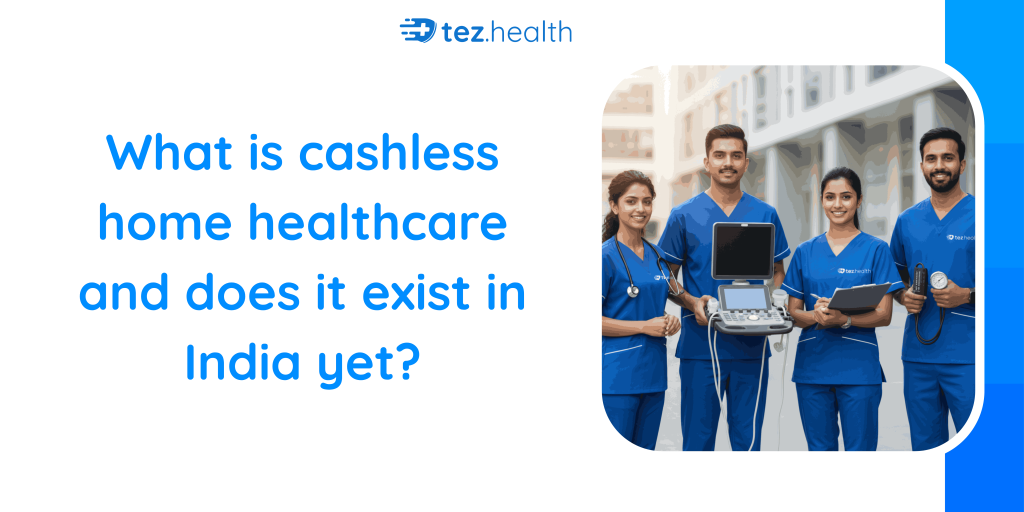
Healthcare in India is no longer limited to hospitals.
Today, patients expect care to be faster, more convenient, and less stressful—not just medically, but financially as well. While home healthcare is becoming more common, one question continues to come up:
Can you get home healthcare without paying upfront?
In simple terms:
Is cashless home healthcare a reality in India yet?
The idea is appealing. You receive treatment at home, and your insurance takes care of the payment directly—just like it does in some hospitals.
But the reality is still evolving.
Let’s understand what cashless home healthcare really means, where India stands today, and what patients should expect.
Understanding “Cashless” in Healthcare
To understand cashless home healthcare, we first need to understand how cashless systems work in general.
Traditionally, when you needed medical treatment:
- You paid the hospital bill yourself
- Then submitted documents to your insurer
- Waited for reimbursement
This process could take time and often required you to arrange a large amount of money upfront.
Cashless healthcare changed that.
In a cashless system:
- The healthcare provider sends the bill directly to the insurer
- The insurer settles the approved amount
- The patient pays little or nothing upfront (depending on coverage)
This model has become common in hospitals—but extending it to home healthcare is more complex.
What Does Cashless Home Healthcare Mean?
Cashless home healthcare works on the same principle—but outside hospital walls.
It means:
- You receive medical services at home
- You don’t pay upfront for covered services
- The insurer directly pays the healthcare provider
This could apply to services like:
- Doctor consultations at home
- Nursing care
- Post-surgery recovery support
- Physiotherapy sessions
- Medical equipment setup
On paper, this looks like a seamless extension of hospital-based cashless care.
In practice, it is still developing.
Is Cashless Home Healthcare Available in India?
Yes, but only in certain situations.
No, it is not widely available across all policies and providers.
India is currently in a transition phase where cashless home healthcare is slowly being introduced but is not yet standard.
Where Cashless Home Healthcare Is Already Working.
Even though it’s not universal, cashless home healthcare does exist in India in specific formats.
1. Through Select Insurance Plans
Some insurers have started including home-based treatment as part of their coverage. In these cases:
- The insurer reviews the case
- Approves the treatment
- Pays the provider directly
However, this usually applies only when the treatment meets strict criteria.
2. Through Partnered Service Providers
Insurance companies often work with a network of approved healthcare providers.
If your home healthcare provider is part of that network, you may be eligible for cashless services.
If not, you will likely need to pay first and claim later.
3. For Specific Medical Conditions
Cashless home care is more likely to be approved when:
- The patient requires ongoing medical supervision
- The treatment would otherwise need hospitalization
- A doctor recommends home-based care
This is not typically available for routine or non-critical services.
4. Through Employer Insurance Plans
Corporate health insurance policies sometimes offer better flexibility and broader coverage.
In such cases, employees may have access to cashless home healthcare options that are not available in standard individual plans.
Why Cashless Home Healthcare Is Not Yet Fully Common
If the concept is so useful, why hasn’t it become widespread yet?
There are a few key reasons..
1. Hospitals Have Established Systems—Home Care Does Not
Hospitals have:
- Standard billing systems
- Dedicated insurance desks
- Clear treatment protocols
Home healthcare, on the other hand, is still building this level of structure and integration.
2. Verification Is More Complex
In hospitals, insurers can easily verify:
- Diagnosis
- Treatment
- Costs
At home, ensuring the same level of transparency requires additional systems and monitoring.
3. Variability in Service Quality
Not all home healthcare providers operate at the same level.
Insurance companies prefer standardized, predictable environments—which hospitals provide more consistently.
4. Policy Limitations
Many insurance policies still focus primarily on hospitalization.
While they may include home care, the coverage is often limited and conditional.
5. Operational Challenges
Cashless systems require coordination between:
- Patients
- Providers
- Insurers
In a decentralized home setting, this coordination becomes more complex.
Cashless vs Reimbursement: What Patients Experience Today
For most patients in India today, home healthcare works like this:
Reimbursement Model (Most Common)
- You pay for the services
- Submit bills to the insurer
- Wait for claim approval and payout
Cashless Model (Limited Availability)
- Treatment is pre-approved
- Provider delivers services
- Insurer pays directly
Why Cashless Home Healthcare Matters.
Even though it is still growing, cashless home healthcare has the potential to significantly improve patient experience.
1. Reduces Financial Stress
- Patients don’t need to arrange large amounts of money during treatment.
2. Speeds Up Access to Care
- Treatment can begin immediately without waiting for funds.
3. Simplifies the Process
- Families don’t have to manage complex reimbursement paperwork.
4. Encourages More People to Choose Home Care
- When financial barriers reduce, more patients consider home-based treatment options.
Elderly Patient Care
Long-term hospital stays can be costly and uncomfortable. Cashless home care offers a more sustainable alternative.
Chronic Conditions
Patients requiring regular care benefit from consistent support without repeated financial strain.
The Role of Technology
Cashless home healthcare depends heavily on digital systems.
Key enablers include:
1. Digital Documentation
- Easy sharing of reports, prescriptions, and treatment records.
2. Real-Time Monitoring
- Devices that track patient health and provide updates to doctors.
3. Faster Approval Processes
- Online systems that reduce delays in insurer approvals.
4. Integrated Platforms
- Connecting patients, providers, and insurers in one system. Technology is what will make cashless home healthcare scalable in the future.
The Tez Health Perspective
At Tez Health, we see a clear shift in how patients want to experience healthcare.
People are no longer just looking for treatment—they are looking for:
- Convenience
- Speed
- Transparency
- Financial ease
Cashless home healthcare aligns perfectly with these expectations.
But making it work requires:
- Reliable service delivery
- Strong coordination with insurers
- Consistent medical quality
- Seamless patient experience
The focus is not just on offering home healthcare—but on making it accessible, efficient, and easy to navigate.
What Patients Should Do Today
If you’re considering home healthcare and want to explore cashless options, here’s a practical approach:
1. Review Your Insurance Policy
- Check whether it includes home-based treatment benefits.
2. Speak to Your Insurer
Ask specifically about:
- Cashless home healthcare
- Network providers
- Approval requirements
3. Get Medical Recommendation
- Doctor approval is critical for eligibility.
4. Choose the Right Provider
- Working with a recognized provider increases the chances of approval.
5. Understand Your Costs
- Even in cashless systems, some expenses may not be covered.
What the Future Holds
Cashless home healthcare in India is at an early stage—but the direction is clear.
In the coming years, we can expect:
- More insurance plans including home care
- Larger provider networks
- Faster and simpler approval systems
- Greater availability across cities
As healthcare continues to move toward patient-centric models, cashless home care will become more common.